
First-time Montana state House candidate Trevor Walter expected voters to question his lack of experience. What he didn’t expect was friends he’d known for years to accuse him of lying when he showed them his opponent’s voting record. The challenge wasn't introducing himself to voters—it was convincing them to believe what the public record showed. Despite the challenges, Walter defeated the popular three-term incumbent.
“The most difficult part of this was educating them in the fact that he voted poorly despite the fact that everybody likes him a lot,” Walter said.
Instead of questioning his experience, many voters questioned the official voting record.
“People who were friends of mine now think that I am a liar,” Walter said. “All I'm doing is trying to help out and calling out some bad voting of our current representative, and yet they refuse to believe that. You can take them to the state website and show them the voting records there. ‘No, you're just twisting it. That's not really what that means.’”
People who were friends of mine now think that I am a liar. All I'm doing is trying to help out and calling out some bad voting of our current representative, and yet they refuse to believe that. - Trevor Walter
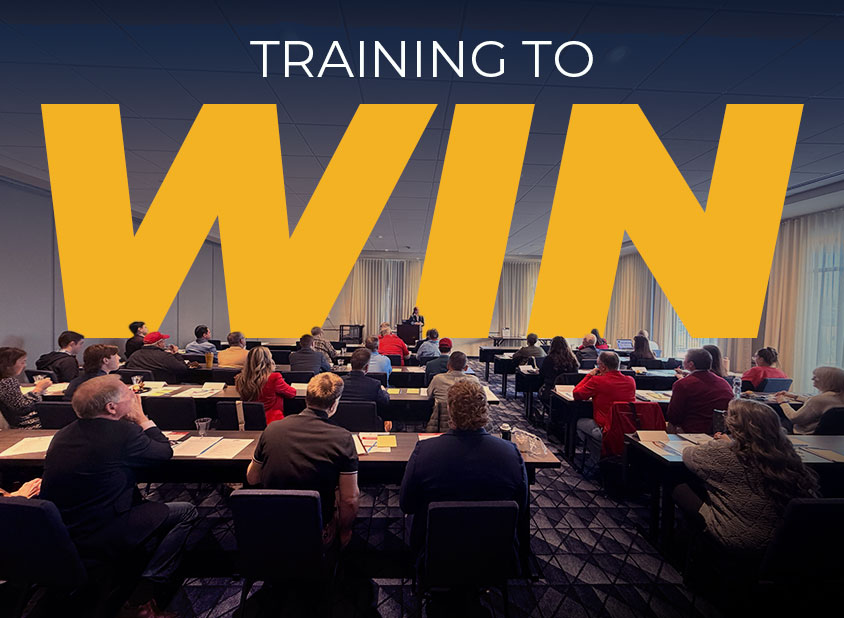
Walter never planned to run for office. After spending three decades running a marketing firm, he agreed to run when his state senator encouraged him to challenge the incumbent. Knowing he had little campaign experience, he looked for training wherever he could find it. Rep. Tom Millett, a Montana Hazlitt Coalition member, pointed him toward Liberty Action's Liberty Candidate Academy, where he later encouraged Liberty Action to host another training in Montana.
“It was totally different from the previous one, and I learned so much from that,” Walter said. “I love the structure and the style, but what I like the most is when you guys came up to Kalispell, Erik Mortensen, who's a former legislator out of Minnesota, was the one that taught the class up there, and he gave real-world examples. That's the thing that I had not seen before in any of the other trainings I'd been to. It was very educational. I absolutely loved that, I learned a lot there.”
Walter already knew how to market a business. Running for office required a different skill: talking to voters who expected answers he couldn't honestly promise.
“I learned a tremendous amount about communication,” he said.
He said LCA taught him how to communicate rather than overpromise when voters wanted promises he couldn’t honestly make.
Walter said those lessons shaped the way he approached conversations throughout the campaign.
He started his campaign a year in advance by crafting a Facebook-heavy digital strategy, and door knocking for the last two months. While his opponent focused on mailers, TV and radio ads, Walter put his money into signs.
“We had over 140 signs that were 3x4 or 4x8, and my opponent had maybe 40 to 60 out at that size,” Walter said. “I had no intention of having that many signs, but I had people that kept calling and asking for them, and they wanted the large signs. They wanted to put them everywhere. That showed me how much support I really had that I just didn't know, and it was quite amazing.”
That showed me how much support I really had that I just didn't know, and it was quite amazing. - Trevor Walter
Traditional campaign events largely fell flat. Meet-and-greets attracted few attendees, but hanging campaign signs unexpectedly turned into neighborhood conversations that sometimes lasted for hours.
“I'd be over putting a sign up and talking to the neighbor, and he might call a few of his friends over, so we'd have little get-togethers when we'd do that, which was kind of unique,” Walter said. “That was an unplanned organic thing that would happen. We'd spend a couple hours chatting with people while we were hanging signs. You go out and you get three or four signs hung in a day and you might talk to 20 people at the same time.”
By election night, Walter believed he had done all he could and resigned himself to whatever the result would be.
“I've knocked every door I can,” he said. “I've sent every email I can. I've made every phone call I can. I've put a sign everywhere I can. I've done everything I possibly can. I'm either gonna win it or I'm not, and there's nothing I can do about it.”
Walter and his wife stayed up until nearly two in the morning refreshing election results on his phone.
“I was ahead the whole time,” he said. “I was winning every district. And sure enough, I still was ahead in the morning.”
Since he doesn’t have an opponent for the general election, he plans to campaign for other candidates with contested races.
“I'm raising money still and we're gonna go out and door knock and do a bunch of work for other folks that do have some really tough generals,” Walter said. “So I'm going to treat it just as if it's my general.”
I'm raising money still and we're gonna go out and door knock and do a bunch of work for other folks that do have some really tough generals. - Trevor Wal
Walter's victory is a reminder that incumbents aren't unbeatable when voters understand their representatives' records. It also shows how Liberty Candidate Academy helps first-time candidates develop the skills they need to run competitive campaigns.
To support Liberty Action in training candidates like Walter, click here.










.jpg)