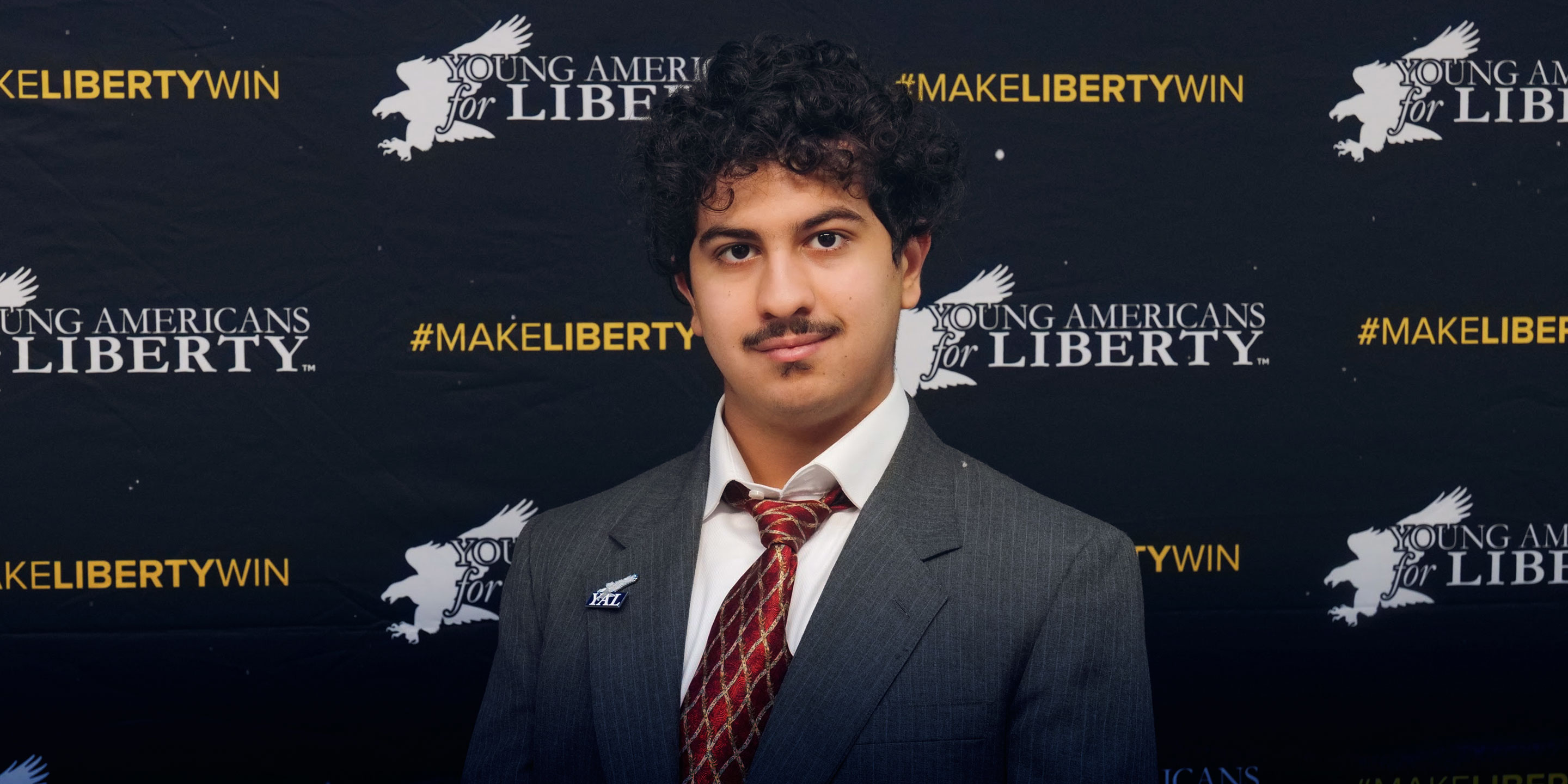

After helping sue the University of Texas system for free speech violations, most students would have called it a win and moved on. Zall Arvandi didn’t. Instead, he leveraged a federal injunction to begin transforming the university from the inside.
Most students never meet with a university president. Even fewer do it while actively suing the university.
Rather than spend the meeting relitigating the lawsuit, Arvandi arrived with another goal: convince the university to remove barriers preventing students from organizing on campus. And he was more than willing to use the federal injunction he helped secure to do it. The meeting eventually led to a significant victory: the university agreed to eliminate Registered Student Organization fees.
"That was something he actually came up with on his own," said Young Americans for Liberty South Regional Campus Director Trenten Rippy. "That wasn't even a policy we were looking at, so he didn't even need us to go after that. He researched the policy and really did all the groundwork on that fight himself."
Student organizations previously paid a $20 registration fee and were required to re-register and pay the fee every semester. After Arvandi raised the issue, the university eliminated the registration fee and changed the registration process to once a year.
“He kind of used this free speech thing as a way to leverage the school,” Rippy said. “It's like, ‘Well, you've already seen how far we're willing to go to fight you on other things, go ahead and comply with some of our other demands too.’”
That meeting only happened because of a legal fight that began months earlier.
In 2025, the Texas legislature passed SB 2972, the Campus Protection Act, that placed multiple heavy restrictions on free speech on college campuses. The bill heavily restricted any sort of public expression from anyone who isn’t a student or employed by the school; banned “amplified noise” or club-invited speakers during the last two weeks of any term; and any “amplified noise” or public expression between 10 pm and 8 am was banned.
YAL activists worked to kill the bill. When that was unsuccessful, they worked with Hazlitt members to amend the bill in the House that watered it down from its original form.
“We were going up to the state Capitol, staying up as late as almost 2:00 am, past midnight on some of these legislative sessions, going around to our Hazlitt Coalition members and informing them about the bill because a lot of them hadn't even caught wind of it,” Rippy said. “And then going around to some other different conservative legislators to try to get them to vote to kill the bill.”
Anticipating the bill’s passage, YAL’s Student Rights Campaign worked with the Foundation for Individual Rights and Expression, also known as FIRE, to sue the state and stop the bill.
“Zall signed on as a plaintiff and attended the court hearing,” Rippy said. “And then he also provided some written testimony to FIRE's legal team, which they were able to use.”
The judge issued a preliminary injunction on the major sections of the bill on First Amendment grounds, barring its enforcement in the UT system.
“I saw it was bad, I wanted to help out,” Arvandi said. “[Rippy] said I could get involved in the lawsuit, and as a student, I decided that that's the best thing to do.”
I saw it was bad, I wanted to help out. He said I could get involved in the lawsuit, and as a student, I decided that that's the best thing to do. - Zall Arvandi
Winning the injunction turned out to be just the beginning of Arvandi’s activism at UT Austin.
Just two weeks after the injunction, some liberty activists, including YAL staffers, were tabling and debating students on the UT Austin campus.
“I didn't even know that was going on,” Arvandi said. “I was just walking by and I saw them and I'm like, ‘Hey, there's a big crowd here. Maybe I should stay somewhere around there because I'm a trained activist.’ I figured I should be there in case something bad were to happen.”
A university official later showed up with police officers threatening Arvandi and the other students with university sanction and forcing non-students to leave campus, in accordance with the new Texas law. However, the law provisions were currently under injunction. The university official was later placed on leave.
The confrontation reinforced Arvandi's belief that the university still hadn't fully embraced the court's ruling—and prompted administrators to invite him to meet with the university president. The meeting gave Arvandi the perfect opportunity to raise some of his concerns with officials.
Arvandi had been reading university policy, and he found something nobody else was working on—fees for student organizations.
“Eliminating the fee is kind of the principle,” Rippy said. “Even if it was just $20 or even $50, it shows that free speech doesn't have a price tag. You can organize without needing a permit, especially because the club was already paid for by the activity fees that students pay into. So it's eliminating that double taxation there as well.”
As YAL's Austin-area state chair, Arvandi has worked hard to grow his YAL chapter and has been incredibly successful.
“We've had multiple staff go out there on that campus and try to get something started, and it's never worked,” Rippy said. “To see someone be able to actually start up a chapter where a lot of other proven people haven't been able to do it was pretty impressive.”
Arvandi’s passion for activism and persistence has been a successful combination for him.
“He's got a real drive for it,” Rippy said. “I think he made that his number one priority and he didn't really get discouraged. Another thing that led to him being successful was Zall really doesn't like to take ‘No’ for an answer. Even when we tell him to slow down on stuff, he still wants to go in 200%.”
Arvandi isn’t finished with UT Austin just yet. He’s already planning his next move with the administration.
“I'm trying to get another meeting with the university president before they have that August Regents meeting so that I can tell him what I want to his face before he goes as a voting member of the Board of Regents to start changing some of those policies,” Arvandi said. “I also want to be there at the Board of Regents meeting and potentially testify on a few agenda items so that I can also nail it into their heads what I like, that I want this stuff gone.”
Rippy hopes more students will look to Arvandi as an example of how to make changes on your campus.
“Zall just sets a good example of what an activist is,” Rippy said. “It's someone that's willing to take that lead. I hope we see more students do things like that. And I think Zall showed that if you just find a policy you don't like, dial up the pressure on it, most of the time you're going to get it changed because these people aren't used to having someone challenge them and they don't want you on their ass every two seconds like Zall was.”
Zall just sets a good example of what an activist is. It's someone that's willing to take that lead. I hope we see more students do things like that. - Trenten Rippy
Arvandi didn’t see the injunction as the finish line. It was simply the first opportunity to change a university he believed could do better.








.jpg)