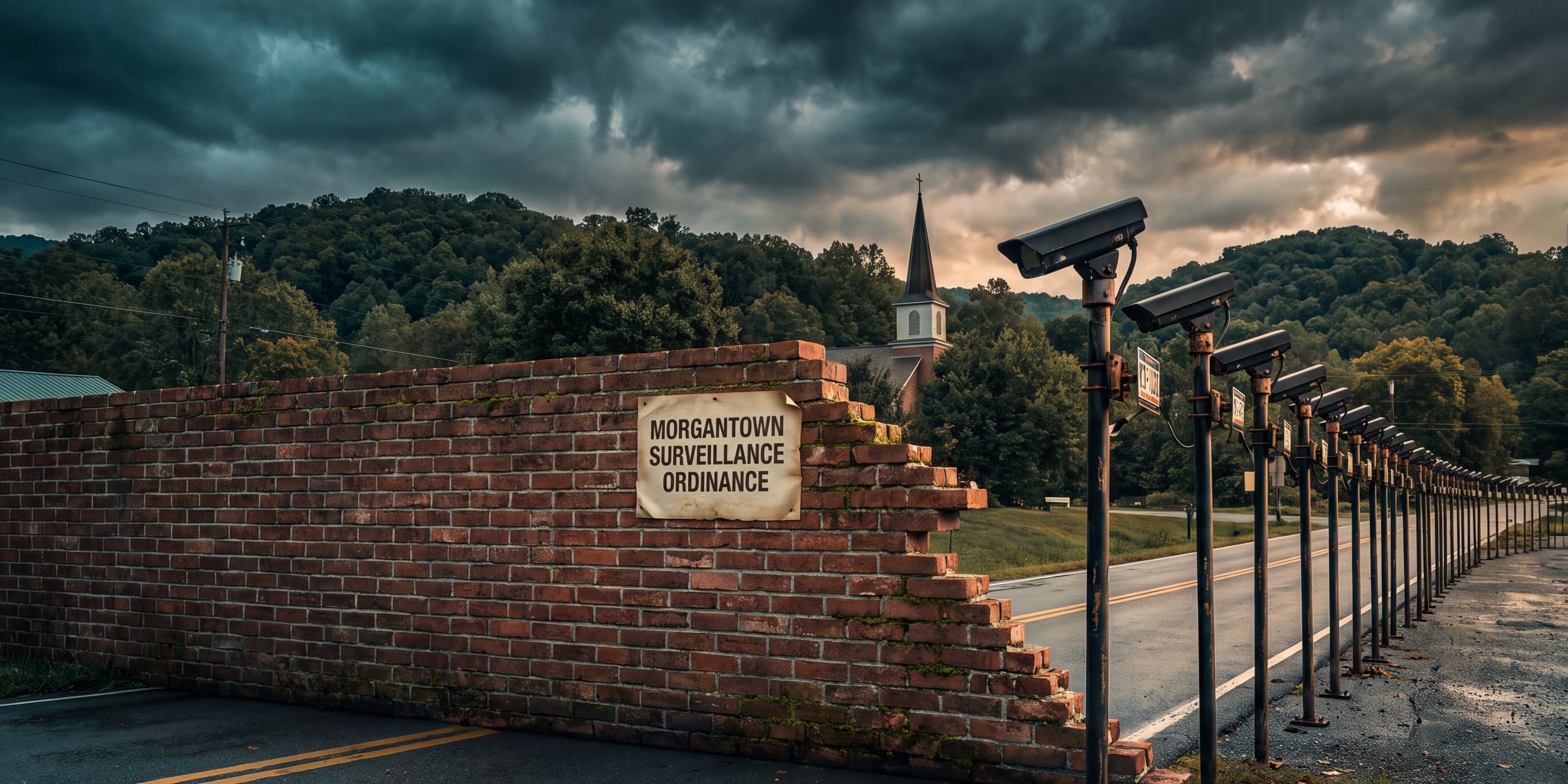

Most local governments buy the cameras first and ask questions later. Morgantown is trying to write the rules first. That deserves credit.
But credit is not a victory lap. Read the fine print, and this ordinance leaves the biggest surveillance network in the county untouched.
What the Ordinance Would Do
On Tuesday, Oct. 6, Morgantown City Council took up an ordinance creating two new sections of city code: Article 116, "Face Surveillance Systems," and Article 117, "Surveillance Technology."
The draft would:
- Bar face surveillance cameras on city property, by the city or anyone else.
- Apply the same bar to automated license plate reader cameras.
- Require a public hearing and a council vote before the city uses other surveillance tools, from cell site simulators to drones.
- Require a written use policy, vendor data certifications, and a yearly public report on each approved tool.
- Give tech the city already uses one year to win council approval.
The council did not vote. Members tabled the first reading to tighten the wording. Council members hoped to bring a revised version back Oct. 20. It missed that target. The ordinance was not on that meeting's agenda, and no new date has been set.
What It Does Not Do
Here is where the praise has to stop and the questions start.
It covers city property only. It would not apply to private property or to state-owned streets. That is a big hole. City Manager Jamie Miller has said himself, "Many of our main corridors are state roads."
It does nothing about the county's cameras. Monongalia County runs 20 Flock license plate cameras on a three-year contract paid with $180,000 in opioid settlement money. The default setup "shares data collected locally with law enforcement nationwide." Whether any of those cameras sit inside city limits has not been reported.
For every other tool, it is a permission slip, not a ban. WTAP describes the proposal as rules for how the city "evaluates, acquires, uses, audits, and manages surveillance technology." Anything on that list can still be switched on with a council vote.
Even its supporters see the gap. Resident Harrison York said it "doesn't outright ban this technology" and "leaves it open to the whims of future councils."
And the public has not seen the text. No published version spells out exceptions, penalties, or whether city police could still search Flock data from other agencies' cameras.
The Liberty Case
The Fourth Amendment protects "the right of the people to be secure in their persons, houses, papers, and effects, against unreasonable searches and seizures." A camera network that logs every car that drives past is a search of everyone, all the time, with no warrant and no suspicion.
Morgantown's draft gets the instinct right: sunlight first, cameras second. But a city that bans plate readers on its own poles while its police can tap a nationwide plate reader network has not banned mass surveillance. It has moved it down the road.
If the council means it, the next version should:
- Keep the face surveillance and license plate reader bans with no loopholes.
- Bar city police from buying or searching outside plate reader and face recognition data without a warrant.
- Set hard limits on how long any data is kept and who it can be shared with.
- Put real penalties in the ordinance for breaking it.
The Bigger Picture
Morgantown is not starting from zero. The city already has one license plate reader at High and Wall streets and 49 downtown security cameras, which the city says do not read plates.
The county keeps Flock data for 21 days, and in one 30-day stretch 101 of more than 570,000 images were searched.
At the state level, 2026 bills to restrict license plate readers did not become law, and Del. Patrick Lucas says he is drafting new legislation for the session that starts Jan. 13, 2027.
The Bottom Line
Morgantown wrote a good first draft. A first draft is not a wall between your car and a government database.
The revised ordinance missed its Oct. 20 target. Whenever it returns, that version will show whether this is a real limit on surveillance or a press release with a code number.